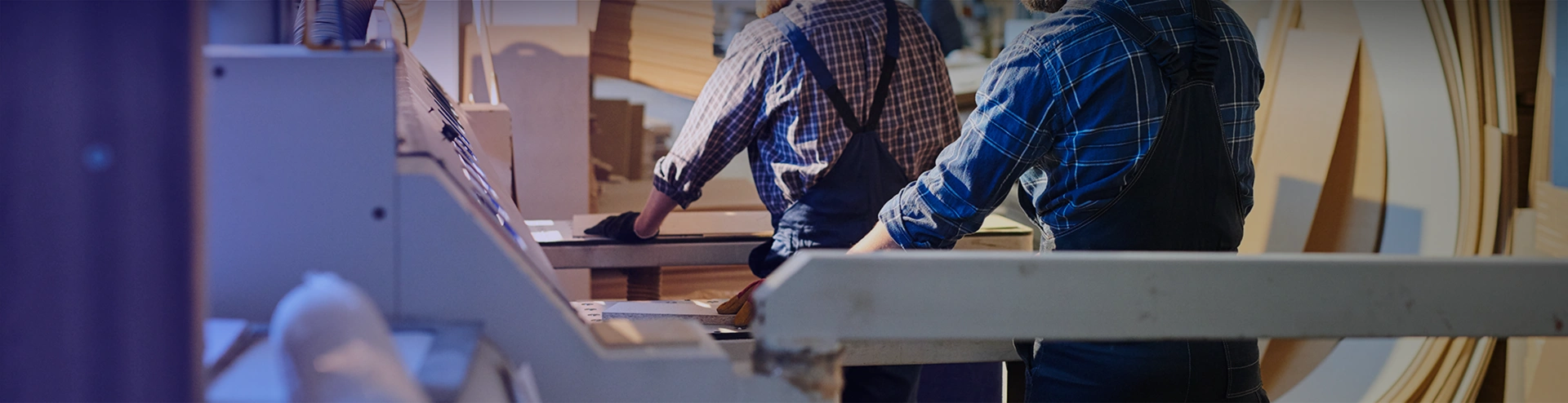

The Holztech finger grafting machine offers exceptional flexibility by processing wood segments into desired lengths ranging from 3000mm to 4500mm. This capacity makes it an ideal solution for producing long structural components used in construction, furniture frames, and architectural elements. By automating the critical process of creating extended wooden beams from shorter pieces, this finger grafting machine enables manufacturers to utilize material efficiently while meeting precise dimensional requirements for various industrial and commercial applications.
Our Manual Edge Banding Machine delivers precision, versatility, and efficiency for small to medium woodworking workshops.
Our CNC Beam Saw is designed for high-quality batch cutting of laminated chipboard and fibreboard to revolutionize production efficiency and processing quality in panel furniture manufacturing. Offering three standard processing sizes—2800mm, 3200mm, and 3800mm—the equipment precisely meets the standardized production demands of cabinetry, wardrobes, and office furniture sectors, providing robust equipment support for large-scale customized production.
The furniture manufacturing industry has a powerful new tool for precision and efficiency with the launch of the Compact Edge Banding Machine Model HT306Y. This innovative machine integrates six essential finishing processes into a single, streamlined unit, offering exceptional versatility and space-saving design for small to medium-sized workshops and custom furniture production lines.
The Holztech MJ6116TY is a space-saving sliding table saw that delivers high cutting efficiency despite its compact footprint. Engineered specifically for small to medium-sized workshops and factories with regular wood panel cutting needs, this machine brings professional-grade precision and productivity to environments where floor space is limited. Its intelligent design ensures this sliding table saw performs robust cutting tasks while occupying minimal workshop area, making it an ideal entry-level or secondary machine for custom furniture makers and cabinet shops.
The Holztech HT280 is a fully automatic panel sizing CNC saw engineered for exceptional cutting speed and throughput. Designed for large-scale production facilities specializing in sheet materials, this machine dramatically boosts efficiency in cabinet, furniture, and fixture manufacturing. By automating the entire cutting process, this CNC saw minimizes manual handling and setup time, enabling continuous, high-volume processing of panels with consistent, razor-sharp precision and optimized material yield for maximum productivity.
Fully Welded Frame and Engineering-Grade Hydraulic System Define a New Standard for High-End Panel Processing
We are pleased to introduce our Automatic Door Lock Hole and Hinge Hole Mortising Drilling Machine, designed to improve efficiency and accuracy in wooden door processing. This machine integrates lock hole drilling and hinge mortising functions into one system, helping manufacturers reduce manual operations and ensure consistent machining quality. It is suitable for solid wood doors, MDF doors, and composite doors.
The HTL-60DS Automatic Edge Sanding Machine focuses on the core requirements of rough edge grinding and primer sanding for wood products, gaining industry attention through its broad material compatibility. This machine precisely adapts to various mainstream wood materials including solid wood, composite panels, MDF, and veneered boards. It efficiently sands and polishes everything from small items like wood moldings, wood flowers, and coat hangers to irregular flat products such as Roman columns, picture frames, and toilet seats, comprehensively covering diverse processing scenarios.
Our Metal Water Sanding Machine is specially designed for precision sanding and polishing of metal, stainless steel, aluminum, and other sheet materials. Featuring a 100mm thick marble conveyor table, it ensures high stability, no deformation, and precise processing results.
Qingdao Holztech Machinery Co., Ltd. has launched the new CNC Router 1325, a robust and precision-focused machine designed to meet diverse industrial cutting, carving, and engraving needs. Featuring a generous working area of 1300×2500×200mm and a reinforced T-slot aluminum table, the machine ensures stable and accurate processing of various materials. Equipped with a reliable 3.5KW air-cooled spindle capable of reaching 18,000r/min, the router offers both power and flexibility, with an optional water-cooled spindle available for extended operation. Its engraving and moving speeds of up to 12m/min and 20m/min respectively enable efficient production without compromising on finish quality.
In the field of woodworking, cold press machine are core equipment for processes such as panel splicing and veneer application, and their performance directly affects the flatness and strength of the finished product. This cold press machine, specifically designed for the woodworking industry, has become a new choice for many processing companies due to its precise pressure control and stable operation, effectively solving problems such as low processing efficiency and uneven product quality associated with traditional equipment.



Copyright © 2026 by Qingdao Holztech Machinery Co.Ltd All Rights Reserved